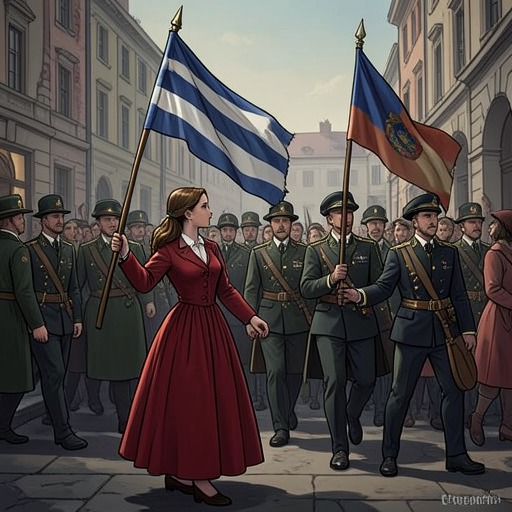
Evangelia Learns Her Family Secret at the Independence Day Parade
Cartes Postales from GreeceAt a rain-soaked Independence Day parade, Evangelia sees an Albanian schoolboy carrying the Greek flag and recognizes that her own family is implicated in the argument over who belongs. The boy’s place in the procession, a flag seller’s tears, and the memory of her granddaughter’s ancestry bring a long-kept secret into focus. What begins as a public dispute about the right to bear the flag becomes a private reckoning with inheritance, silence, and the limits of the national ideal on display.
A Parade Under Strain
The parade nearly had to be called off because of the rain. The streets were slick, and the awning sheltering the mayor and other dignitaries sagged under repeated downpours. Musicians continued playing despite the cold, their fingers stiff beneath their white gloves; the drummer, keeping time for hours, was the only one able to maintain his circulation through vigorous movement. The route followed the seafront, where a cool wind came in across the Gulf, while Mount Olympus was hidden by grey cloud. These details place the ceremony in a setting where the formal display of civic pride is physically strained, but the procession goes on.
The parade’s order gives the national flag a conspicuous place: school representatives follow one another, with boys leading their school’s contingent. That public arrangement becomes consequential when a dark-haired, exceptionally handsome and notably tall boy appears at the front, carrying his flag with conviction. His position makes him visible not merely as a student but as a representative of the nation in a ceremony devoted to national identity.
The Dispute Over the Flag
A woman beside Evangelia objects that the boy should not be carrying the flag. Another woman answers that he is top of his class and that this is why he has been selected, whether the objector agrees or not. The exchange sets two different standards against one another: academic achievement, which provides the stated basis for his role, and an unspoken test of belonging, which makes his ancestry seem disqualifying to the objector. The scene does not resolve that disagreement through debate; the boy continues marching, and the ceremony itself supplies its own answer by allowing him to carry the flag.
As he comes level with Evangelia, the boy glances toward her and smiles. He then turns forward and waves the blue-and-white flag so that it unfurls above the procession. The gesture is part of his formal role, but the moment also directs Evangelia’s attention to the silent man standing beside her, a flag seller whose eyes are full of tears. She understands why the boy looked their way. The narrative links the boy and the man through this look and through Evangelia’s recognition, making the public procession a scene of personal acknowledgment as well as civic display.
Evangelia Recognizes the Parallel
The surrounding conversation moves on, but Evangelia remains troubled by what the Albanian boy may have heard. She hopes his Greek is too poor for him to have understood the comments. Her shame deepens not only because she did not support the woman who objected to her neighbour’s remarks, but because the incident makes her see that the judgment being applied to the boy reaches into her own family. Her reaction is therefore more than sympathy for a stranger: she recognizes that the standard being invoked could also exclude her granddaughter.
Evangelia’s realization rests on a specific family history. The father of her child, like the father of the boy who had passed in the procession shortly before, had spoken little Greek. Her granddaughter, she understands, does not have the ancestry that would satisfy an idea of unbroken Greek descent. The comparison does not establish that the two families share the same background; it exposes the similarity that matters to Evangelia: in both cases, a father’s limited Greek marks a connection beyond the narrow identity assumed by those judging who may carry the national flag.
A Secret That Endures
The crucial knowledge is not newly created by the parade. What happened in Evangelia’s family took place many years earlier, but the secret has persisted, and she believes she is the only person in the world who knows it. The boy’s appearance and the argument around his selection bring that concealed history into the present. In this way, the revelation is also an act of recognition: Evangelia sees that the public rule being asserted against the boy would, if applied consistently, cast doubt on her granddaughter’s right to belong as well.
The episode closes not with a public disclosure but with Evangelia’s inward acknowledgment of what she has kept hidden. The flag remains a visible emblem carried in the parade; ancestry, by contrast, is an intimate matter that cannot be read from the procession alone. By placing the two side by side, the scene shows how a claim about national purity can conceal private histories within the very families that appear to belong. Evangelia’s shame marks the cost of having remained silent, while her recognition connects her granddaughter’s unspoken history to the boy and father before her.